Back to Florida, and back to reggae. Interestingly enough, today we have the #1 rated album on rateyourmusic.com’s Top 10, “Heart of the Congos”, by another Jamaican act, The Congos. Not Bob Marley, not Peter Tosh, not Toots and the Maytals, it is… The Congos. At their core, The Congos are a two-person vocal act, including Cedric Myton, who sings in falsetto, but the album has a full collection of instrumentalists and backing vocalists as well.
While I certainly would be hard-pressed to rate this as the greatest reggae album ever, it was another positive discovery on my expanding reggae journey. Their sound features most of the melody coming from the vocals and bass line, with less guitar than some of the other acts mentioned above. You get a fairly good idea of where this album is going with the first song, “Fisherman”, and the album has many of the same themes of Jah and repatriation back to Africa. While it was a pleasant listen, there wasn’t too much that was particularly noteworthy, and the production came across as a bit more dated than some of the other music of its time and genre. The two most catchy and infectious songs are back-to-back, with “Children Crying” and my #1 favorite, “La La Bam-Bam”.
I don’t know how many more reggae acts remain in the Top 10 list which sources my master list, as clearly most, if not all, are vintage from the 1970s. The Congos have continued to perform and stay active to this day, which is fantastic. They added a baritone to their trio, which I can only assume further rounds out their sound.
A third straight punk rock album? What is happening here? That’s what it looked like, as I began to play “Rattus Norvegicus” by the UK band, The Stranglers. By the way, “Rattus Norvegicus” is the species name for brown rat. So… yeah. This album is #8 on loudersound.com’s Top 10 Punk Rock albums of all times.
I steadied myself and prepared for another day of aggressive two to three chord songs, played really fast with lots of spit and venom. While The Stranglers certainly have a punk attitude, their sound is much different than The Damned or The Clash. Most notably, while there is a lead guitar, the most prominent source of melody in each song is a bright and cheery keyboard, augmented by some snappy bass lines. This lineup, which has shifted many times over the years, featured Hugh Cornwell on guitars and vocals, Jean-Jacques Burnel on bass and vocals, Jet Black on percussion, and the talented Dave Greenfield, doing his best Ray Manzarek impression, on keyboards. Sadly, Dave Greenfield died in May of 2020, and is the first musician I have read of during this journey who died because of COVID-19. Get your shots and wear those masks, please and thank you.
The tracks are an eclectic mix and certainly offer a variety of sounds and styles. I particularly favor the opener, “Sometimes”, “Goodbye Toulouse” (the second artist on this list to mention Toulouse, although in this case it is in reference to France, not New Orleans), “Peaches”, which was the most successful and well-known song on the album, and since we are talking about sewer rats, we might as well have a song called “Down in the Sewer”.
Like I said, this band has plenty of punk sneer, but their overall sound is more like a blend of The Sex Pistols, The Doors, Primus and Sublime. They have had a long and enduring career as a band, and are currently planning their farewell tour in tribute to Dave Greenfield. Be safe out there, and enjoy The Stranglers!
The punk rock surge continues with the debut album from The Clash, another UK act. More so than some of their peers, The Clash both evolved and devolved with time, moving beyond their punk roots to a more blended sound that has even migrated to the world of classic rock. That said, this first album is pretty true to their roots, and it is another good introduction to the fast and furious sounds of the time. Highly regarded, this album is #102 on Rolling Stone’s Top 500 Greatest Albums of All Time.
Led by guitarist and vocalists Joe Strummer and Mick Jones, all of the songs were also written by Strummer and Jones, except for a reggae-ish cover, “Police and Thieves”. It is great to hear their take on this song, and it is one of my favorites on the album. One of the perils of punk rock, in my opinion, is providing enough diversity in sound and style so that each song is distinguishable from the next. There is a bit of that within this record, but there are definitely some standout tracks as well. The opener, “Janie Jones”, has a great sound and is my other favorite track on the album. We also have “I’m So Bored With the USA”, and I have to say, based on a lot of the nonsense I have witnessed the past 5 years, I’m pretty worn down by it too, Joe. My two other preferred tracks are “London’s Burning” and “Career Opportunities”; who isn’t looking for one of those?
It will be interesting to watch the divergence of these many UK punk acts as their careers progress, and The Clash certainly remain original legends in the hallmark movement of punk rock around the world. The music industry was definitely on the move, and there was no turning back.
As promised, we bash into 1977 with the sound of change. Starting in February, we get the first full-length UK punk rock album from The Damned. This album was produced by Nick Lowe and is the #5 rated punk rock album by loudersound.com.
It is ironic that just two days ago we were discussing Led Zeppelin and their 30-minute rendition of “Dazed and Confused”, as it is exactly that kind of indulgent excess that punk rock violently pushed back against. The real irony, as I was hinting at, was that Robert Plant and Jimmy Page were actually both big fans of The Damned and their raw energy and frequently went incognito (as much as those two guys could) to see them play. Punk rock, which broke out in 1977 in a big way, has always been a complicated genre for me as I think I have mentioned it before. Underneath all the anger, aggression and intense fury, it still needs to be good musically in some way for me to appreciate it. With each new punk rock album, I hope I’m not listening to whatever band finished in 4th place behind Alice Bowie at “The Rock Fight”. (If you know, you know).
To be fair and honest, this album concerned me the first time through. I wasn’t getting much to dig into, and I was concerned I was going to struggle here. To make sure I didn’t jump ship too early, I made sure to give it 2-3 good listens in the car on a longer drive home tonight, and I have to tell you, by the 3rd listen, I was definitely hooked. Some songs more than others, but this band could bring it. Simple punk rock power-chords and rhythm frenzy, but there are many diverse sounds as well. I quickly honed in on the first song, “Neat Neat Neat”, which proved to be their most popular song on the album. That song would easily qualify for my Top 10 list of new songs (to me) I have discovered on this journey.
The rest of the album, while not quite at that level, was everything I could have hoped for in a highly acclaimed punk rock record. Fast and intense, but with great musical structure and creativity, songs like “Born to Kill”, “Feel the Pain”, and “New Rose” stood out above the crowd. On the streamed version (which is not on the original album) there is even a great punk cover of “Help” by the Beatles. Led by guitarist Brian James, and one of my favorite musician names, drummer Rat Scabies, this band could deliver as promised and I can only imagine what the energy must have been like at an early show in the UK.
Moving into 1977, this was a big year in popular music for me. Today’s album was one of my favorites, and not only do I remember actively tracking all of the singles in the year-end countdown, it was one of my first real rock records I fully embraced from front to back. Sure, I had dabbled with Elvis and The Beatles among others, but these were hand-me-downs from my parents. This album was all mine. It also turned out to be the #1 selling album of 1977. We are talking about the highly successful album from Fleetwood Mac, “Rumours”, the second release in their most famous lineup configuration, with Lindsey Buckingham, Steve Nicks and Christine McVie handling all of the vocals, while original members Mick Fleetwood and John McVie (hence, Fleetwood Mac) held down the rhythm section on drums and bass guitar. This highly acclaimed record is rated #7 on Rolling Stone’s Top 500 Greatest Albums of All Time.
I recently noted that the debut album from Boston was the only non-compilation album I could think of where every single song realized significant radio air play, but this one comes pretty close. Were it not for a couple of Christine McVie ballads that don’t bring the same energy or draw to the record, they might have done it. Oddly enough, with all of the smash hits on this album, the record opens with the decent, but relatively ordinary “Second Hand News”. The next four songs are probably the peak of the album, as well as for the band. As many of you know, Stevie Nicks and Lindsey Buckingham were in the midst of a tough breakup, which couldn’t have been easy to keep working together. Their cathartic release appears to be writing not-so-passive-aggressive smash hits about each other. First, we have “Dreams”, where Stevie tells Lindsey and others who will listen, “Players only love you when they’re playing.” This song is probably the best work from Fleetwood on drums. It has a great mellow vibe, and oddly was the inspiration for a bizarre Tik-Tok video craze recently.
Anyway, next comes one of my all-time favorites, the acoustic guitar country-folk ballad “Never Going Back Again” by Buckingham. He is probably the only rock guitarist I know who plays almost exclusively without a pick, and his guitar work on this song is crisp and pristine. We then have another of my favorites, the incredibly catchy “Don’t Stop”, with the almost inter-changeable vocals from Christine McVie and Lindsey Buckingham. I truly love the melody and chord sequence of this song, and I try to block out of my mind the Clintons and the Gores dancing onstage to this song in 1992.
Next, we have Lindsey’s response back to Stevie, with the fairly direct “Go Your Own Way”. Not many hidden messages in that song, but is yet another classic track that defines the sound of this band during this timeframe. As I mentioned, while that four-song run is the peak of the album, there are several other highlights as well. The heavier rocker, “The Chain”, with the only bass solo I have ever heard from John McVie, opens side two. Christine McVie hits a pop home run with “You Make Loving Fun”, and I really love the quirky duet harmony from Lindsey and Stevie on “I Don’t Want to Know”. The album ultimately closes with “Gold Dust Woman”, sung and written by Stevie Nicks, and while a success, it has never been one of my favorites.
To this day, this album remains a significant part of my past, and when my son reacquired it for his collection of albums in his dorm room, I now have it as a part of my vinyl future as well. With that, we are off and running into 1977, a year that would usher in a LOT of change in the prevailing sounds of rock and pop music for many years to come.
As I picked my list of albums, I intentionally stayed away from compilation albums, unless those were the only way to catch all of an artist’s major contributions, particularly before albums became a thing. With a “Legend” like Bob Marley, who I am including most of his major releases from the 1970s, I may not have included today’s album. However, there are two very good reasons why it is here. One, it is rated #48 on Rolling Stone’s Top 500 Greatest Albums of Time, so by process, it has to be here. And to be fair, the album “Legend – The Best of Bob Marley And The Wailers” is one of the most significant and well-known compilation albums of all time. For probably 95% (or more) of casual or beginner reggae fans, and you certainly could have lumped me in with this at one point, “Legend” was the point of entry and the one album or CD that we all owned.
Many of these songs are on albums we have already addressed, and I’m guessing there are more still to come. This collection ultimately wasn’t released for the first time until 1984, but I chose to insert it here, during the height of his great run of records. Even the most novice of reggae fans will probably recognize almost every song on this record, and rightly so. Even to this day, on a beautiful day like today as I was overlooking the waves, Marley is required listening for me as I approach the ocean breeze with a happy heart. The mix of songs has evolved slightly over years with subsequent updates and releases, but the basic lineup is relatively unchanged.
The vibe opens so smoothly, with “Is This Love”, and then we move right into a live version of “No Woman, No Cry”. The tight and crisp “Could You Be Loved” comes next, followed by one of his sweetest and happiest songs, “Three Little Birds”. The anthemic “Buffalo Soldier” comes next, and then we have one of my personal favorites, the militant “Get Up, Stand Up” which has a great verse from Peter Tosh.
The perfect chord sequence opening of “Stir It Up” then leads us into “One Love / People Get Ready”, perhaps the most replayed and covered collection of reggae we have ever heard. Marley’s original (yes, original!) version of “I Shot The Sheriff” comes next, and this album just never loses pace with greatness. As if everything I have already cited wasn’t spectacular enough, the last five songs are the gorgeous “Waiting In Vain”, the hopeful “Redemption Song”, the groovy “Satisfy My Soul”, the powerful “Exodus”, and perhaps his signature song above all the others, the perfect track to close it out, “Jamming”. On the version I streamed today, “Easy Skanking” and “Punky Reggae Party”, two songs relatively new to me, are also in the track list, but I focused primarily on the 14 tracks from the original “Legend” release.
Greatest hits albums are intended to be just that, the very best of an artist’s many creations over a long and remarkable career. True to the name, this album and Bob Marley himself were and are legends who exemplify not only an entire genre of music, but still serve today as the cultural icon of an entire nation.
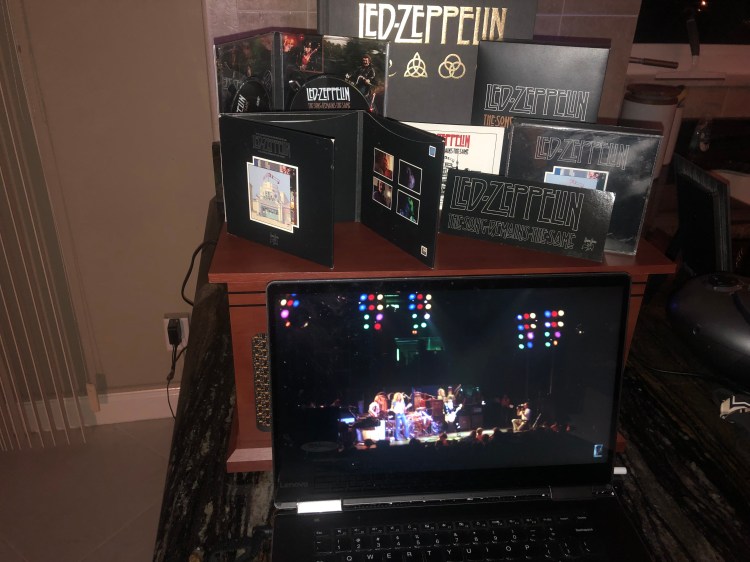
In late 1976, Led Zeppelin released their live album soundtrack to the film, “The Song Remains The Same”. Although I didn’t begin my lifelong fascination and fandom for the band until several years later, this album and film were one of the defining components of my musical existence from about 8th grade leading up to college. There are so many memories, so many thoughts… I will see how many of them I can capture in a single post.
Around 8th grade, I began to notice “Led Zeppelin” scrawled everywhere around my junior high school. In books, on lockers and desks, and anywhere else you turned. Giving in to the curiosity, I discovered this four-person band that captured my attention like no other as I dove into the world of rock music. Even as I acquired most of the studio albums, the obsession continued as we all imagined what it would have been like to see the mighty Zep live in concert. Prior to the days of the internet, our practical access to live footage was limited to this album, and this film, and consume it we did.
In addition to taking our boom-boxes with us anywhere we could with this double album constantly on play, we realized that the film was still accessible on a weekly basis, at the midnight movies. Showing along with “The Wall” by Pink Floyd, and “The Rocky Horror Picture Show”, “The Song Remains The Same” became our weekly obsession to attend, whether it be through the generosity of some parent being willing to drive, or even better, one of us acquiring a car, a license, some gas money, and permission to drive and stay out late. We didn’t always make the best decisions prior to the show, but two and half hours in a theater was enough to sober anyone up, and the biggest challenge by the end of the film, particularly during John Bonham’s drum solo on Moby Dick, was just staying awake at 2 AM.
For those like me who truly obsessed over Led Zeppelin, each screening was a magical transportation back to a world that we could never again experience in person, due to the tragic death of John Bonham in 1980. This was the closest we thought we would ever come to seeing the band live, and with a few rare exceptions, we were right. The film itself is a mixed bag. The cinematography is far from great, and some of the movie has stood up to the test of time better than other parts. However, the basic premise still gets me going, 40 years later. After 15 minutes of previewing life off the road for the band, they gather in New York City, taking a police escort through the Lincoln Tunnel to Madison Square Garden. We even get a few shots of the relatively new World Trade Center towers, as this concert was filmed in 1973. As “Bron-Yr-Aur” softly plays in the background, the band readies, as does the crowd, and we are then presented with a darkened arena full of screaming fans. Over the din, we hear Bonzo yell “Alright, let’s go!” and the first cymbal crashes of “Rock and Roll” kick in. When the guitar rips on, the lights explode and there they are, the most electric and powerful band of their time, taking the stage to dominate for the next three hours.
The film covers most of the concert in approximate sequence, and each of the four band members has a “fantasy sequence”, like a music video, that runs during a song of theirs that particularly features their performance. At the end of the film, after an explosive and fiery performance of “Whole Lotta Love”, the band is escorted back to the airport, where they board their custom 720 Starship plane, to fly off to their next destination. At that time, and even today, Jimmy Page, Robert Plant, John Paul Jones, and John Bonham were absolutely larger than life, and they had a tight grip over the cultural community of rock music in the 1970s, and their dominance of that genre remains ever-present to this day.
The album itself is an interesting story. It is a double album, and the original soundtrack release was the one we all memorized by note, through the 1970s up until the 2000s. They ultimately released another version of the album, re-mixed, with the rest of the concert that was not included on the first version. It is a higher quality production, but Jimmy Page altered several of the tracks noticeably, so it has its pros and cons. He was known for tinkering with several different versions to mold the version he liked best, and if you really want to geek out, there is no better source for this than this website here, The Garden Tapes – The Song Remains The Same .
On the original album, after the opener, “Rock and Roll”, you have the amazing guitar solo on “Celebration Day”, and the rest of side one is just as phenomenal, with spectacular versions of “The Song Remains The Same” and “The Rain Song”. Although I think there are better versions of “Rock and Roll” now available, the other three are as good as I can find anywhere.
Side two is one song… the nearly 30-minute live version of “Dazed and Confused”. In high school, one of our classmates, who shall remain nameless, pushed back as we were rocking to Jimmy Page’s bowed guitar solo, saying, “It’s just so shrill!”. It’s an acquired taste for sure, and not for those with a short attention span, but for Led Zep fanatics, it is Jimmy Page’s ultimate showcase.
Side three opens with another “best of” version, “No Quarter”, featuring John Paul Jones on organ, and then what I consider to be just an average version of “Stairway to Heaven”, other than some of Robert Plant’s entertaining in-song ad-libs. “Stairway” was tough to re-create live, as it missed the initial acoustic opening that allowed for further build, and even by 1973, Robert Plant’s voice had lost the upper range the last part of the song required.
Side four opens with the 12-minute version of “Moby Dick”, Bonham’s extended solo assault on the drums. Although it was always at risk of being too much of a good thing, at its best, it was the best drummer in rock music being the best drummer in rock music. The album concludes with an extended version of “Whole Lotta Love”, which included a 5-minute rockabilly jam improv in the middle section.
On the new release, we get several tracks that were in the film, but not on the original album. We get the best version of “Since I Have Been Loving You” that I have heard to this day, and Page’s guitar solo is from another world. We also get the entire version of “Heartbreaker”, along with previously unheard presentations of “Misty Mountain Hop” and “Over the Hills and Far Away”. From the film, we have a raucous version of “Black Dog” with a great audience sing and respond, and the actual last song of the concert, a tearing rendition of “The Ocean” where Bonham not only counts off the opening chant, he also sings harmony backup vocals with Plant.
Most Zeppelin fans will tell you this was a good, but not great performance by the band. It was at the very end of a long tour, and as noted, Plant’s voice was already a lesser entity as a high-end dynamo after years of overuse and abuse. That said, for us, for more than two decades, other than the odd bootleg audio performance, usually of mediocre sound quality, this was our only captured representation of Led Zeppelin live, and we treasured it.
I will never forget those dozens of times we challenged the clock, authority, our bodies and common sense to go see that movie. Mike, Jim, John, Matt, Shane, Doug, and many others I’m sure, although those are the names I most commonly associate with our weekly pilgrimage to the midnight movie. This movie and album truly framed most of my growing years, and I wouldn’t change a thing. I committed this day to listening to both versions of this album, and on top of it, I then watched the movie in its entirety, with a clear head and focused mind tonight. It was just as I remembered it, and in many ways, surprisingly better than I expected.
Finally, tonight around 9:00 PM, the Zeppelin marathon ended, and I headed to the gym for a late workout. With one last sign that this is the world of Led Zeppelin and we are just living in it, as I walked into the gym, the first riff of “Black Dog” was blasting… “Hey, hey mama, said the way you move, gonna make you sweat, gonna make you groove…”
Yes indeed, after all of these years… The Song Remains The Same.
I know it is all subjective, but now as I have listened to the first five Eagles albums, it is impressive to me that I feel like each one continues to improve on the previous release. That trend can’t last forever, but I do feel like their fifth studio album, “Hotel California”, is by far the most comprehensive and best record they have produced and released to date. Ranked #118 on Rolling Stone’s Top 500 Greatest Albums of All Time, this album continues to showcase Don Henley and Glenn Frey as the unquestioned leaders of the band, introduces Joe Walsh in place of Bernie Leadon, and not coincidentally, take the next step down the rock path while leaving solid traces to their country rock roots.
The album opens with the iconic title track, which is every bit the extended classic rock anthem that “Hey Jude”, “Stairway to Heaven”, or “Free Bird” are. Written musically by guitarist Don Felder, Glenn Frey and Don Henley, who sings the song, wrote the lyrics and finished the melody, and Walsh shaped the closing outro to the guitar solo. Like many songs from a variety of genres that pay tribute to the Golden State, this song is broadly considered to be an ode to fame and the southern California way of life, that was considered to be a one-way door by the band. There is probably no other place in America, other than possibly New York City, that is as frequently cited and serenaded like California. Without even straining, I could name 20 songs about California, and I bet you could as well.
Another well-known ballad from Frey, “New Kid in Town” follows, before one of the faster rockers, “Life In the Fast Lane”, another Henley track, kicks the pace back up. For some reason, whenever I hear this song, I think of my friend Matt, who always referred to this song as “Flies In the Last Lane”. That aside, it is a good track, and as a matter of obscure trivia, it is the song the garage band at Ridgemont High is playing when the prom scene first opens.
“Wasted Time” is yet another Henley song (remember when he only sang one or two songs on their early albums?), and it is indicative of the passionate songs that would mark his solo career after the Eagles broke up. One of the best songs on the album, and in their catalog, “Victim of Love”, again sung by Henley, rocks in a manner, thanks to Felder and Walsh, that was unimaginable before those guys joined the band. Joe Walsh sings his debut song, the forgettable “Pretty Maids All in a Row”, and speaking of forgettable, next comes a Randy Meisner song, “Try and Love Again”. He gives it his best, but there is a reason why Henley and Frey are doing most of the singing now. The album closes with one last Henley ballad, “The Last Resort”.
By this point, the Eagles were dominant superstars in the rock domain, with multi-night stadium sellouts and millions and millions of records sold with this release. The band had certainly evolved in sound and in lineup again, but once again, the changes were for the better, at least from where I sit and listen.
I invested a little extra time and attention on top of a busy weekend to make sure I gave today’s album its full consideration. I listened to it with my friend Mike as we were driving into DC the other night, but realized it needed at least one more focused listen to fully appreciate this highly acclaimed double-album from Stevie Wonder, “Songs In The Key Of Life”. This album is rated as the #4 album on Rolling Stone’s Top 500 Albums of All Time, and it is definitely a great record. It is also rated as #3 on digitaldreamdoor.com’s Top 10 Funk Albums of All Time, and while I wouldn’t call a lot of Stevie’s music as pure funk, there are definitely some funky grooves on this album. This album took two years to release following his last album, which allowed for a rare year in the 1970s when Stevie Wonder did NOT win Album of the Year at the Grammy Awards. This prompted winner Paul Simon to note, “Most of all, I’d like to thank Stevie Wonder, who didn’t make an album this year.”
This record starts with the beautiful warm vibe of “Love’s In Need of Love Today”, and is followed by the legit funk of “Have A Talk With God”, which is just an outstanding song. Not long after, we have the blockbuster doubleheader of “Sir Duke” and “I Wish”, two of the very best Stevie Wonder songs ever, both of these songs are all-time classics. The horns at the end, and the overall bass-line and melody of “I Wish” is a great extension of what he first captured on “Superstition”, earlier in his run.
Next comes “Knocks Me Off My Feet”, which I actually recognized more readily as a staple of my son’s a capella group. Another unanticipated revelation was “Pastime Paradise”, which clearly was about 95% of the songwriting for the early 90s hip-hop hit “Gangsta’s Paradise” by Coolio. Other great songs include “Isn’t She Lovely”, blended in with Stevie’s recent new daughter Aisha, “Joy Inside My Tears”, which reminds be of a retro Prince ballad, “Black Man” and “Ebony Eyes”.
We have covered a lot of Stevie Wonder and I may have even said this before, but this one now moves to the top of the list. There are just too may high moments, some expected and some unexpected, that in total, make this his very best, and in agreement with Rolling Stone, one of the most comprehensively greatest albums in popular music.
Today’s album was released in Australia in 1976, but didn’t make it to the United States for 3 more years. That said, we have the next release from AC/DC, and we have the next round of double-entendres and not-so-double-entendres with “Dirty Deeds Done Dirt Cheap”. As my friend Mike noted while we are listening, there are just certain songs you know from the very first chord, and that is one of them.
Leading the charge again, we have Bon Scott and the Young brothers, with much more naughty than nice. After the title track, we have “Love at First Feel”, and the timeless high society classic, “Big Balls”. Next comes another straight-up borrow from Little Richard, “Rocker”, and side one ends with another strong groove, “Problem Child”.
Side two isn’t quite as much fun, but there is one really strong highlight, the slow blues roll-out on “Ride On”. I always enjoy hearing AC/DC change pace, and this song is one of their very best examples of how that works. A simple formula perhaps, but another really strong album that shapes their defining sound in the 1970s.
 A Lifetime-Plus of Music