Every now and then, I find an absolute gem, a song or album I really had never heard before, that just blows my mind. Today is one of those days. The album is “That’s the Way of the World”, by soul/funk/R&B legends Earth, Wind, & Fire. This album is #490 on Rolling Stone’s Top 500 Greatest Albums of All Time. While I enjoy most of the album, there is one song that is on a different level.
Track #3 is “Happy Feelin’”, and the bass on this song, by Verdine White is literally out of control. This is one of the absolute best and funkiest bass lines I have ever heard. It has a nice island dance feel with congas, xylophones, horns, and the smooth vocals of Philip Bailey, pride of Denver East High School and the University of Colorado. If I could add this song to my playlist more than once, I would do it.
The opening song is their biggest single from the album, “Shining Star”. You probably already know this song, but if you are a Seinfeld fan, you will instantly recognize this song as the number Elaine Benes tried and failed with her horrific dance moves. It’s a happy and poppy song, and a good listen as well.
The second song is interesting as well. If you ever wonder where Lenny Kravitz got the inspiration (and chord progression) for “It Ain’t Over ‘Til It’s Over”, he clearly borrowed from the title track, “That’s the Way of the World”. It is no accident that I love the smooth feel of both songs, and again, Philip Bailey is just amazing on this song. With leader Maurice White, this band has a great feel, and the entire album flows easily. Some of the slower ballads aren’t quite as interesting to me, but they keep bringing it back to up-tempo, especially on another great evolving song, “Africano”.
This album was a soundtrack to a movie of the same name, starring the band as a fictional representation of themselves, and also starred Harvey Keitel. To clarify, Harvey was NOT in the band. The movie didn’t do much, but the album was a big hit, and thankfully, I was able to encounter the Verdine White bass insanity that will be a permanent add to my heavy rotation.
At some point, this day had to come. For many years, when asked what my favorite album of all time was, the answer was inevitably “Physical Graffiti”, and even today, it is still a strong contender for number one. It’s no secret to those who know me that I’m a passionate Led Zeppelin fan, and the diversity, quality and quantity of music on this album are just everything I love about music. By 1975, the cracks were starting to show through on the armor of Led Zeppelin, who had ruled the world of rock music for several years since the Beatles had disbanded. Drug use, bad karma, and differing opinions on the future direction of the band would take their toll all the way up until the tragic death of drummer John Bonham in 1980, and by 1975, the bulk of their best live performances and recorded work were in their rear-view mirror. This double album, which included eight new tracks and seven previously recorded and unreleased songs, was their final triumph of greatness, at least to this Zeppelin fan. Their last two studio albums, which of course will appear later in the journey, were less consistent and frankly lacked the harmony and collective contributions of all four band members that were so natural on the first six albums.
Side one opens with the intense and urgent rocker “Custard Pie”, one of several songs on this album that have Jimmy Page, John Paul Jones, and John Bonham at their very tightest. By this point, Robert Plant could no longer reach the same upper range, but he evolved his voice in many ways to sustain his impact as one of rock’s greatest vocalists and front-men. “The Rover” follows, with a nasty Page riff and more collective greatness from the other three, and side one concludes with the traditional blues song “In My Time of Dying”, which I was very surprised to hear earlier this year recorded by Bob Dylan. I think you could argue this version gets a little excessive in duration and arrangement, but the basic slide guitar and drum power of this song is remarkable.
Side two opens with the song “Houses of the Holy”, and yes, that song was originally recorded and intended to be released on their album “Houses of the Holy”, but didn’t make the final cut. Honestly, I like it a lot more than several of the songs on “Houses of the Holy”, so I’m happy it emerged here. Plant’s vocals take you back to his high-end domination, with another great Page riff. Next comes “Trampled Underfoot”. This is a tough one for me, it is easily one of their most recognized songs on this landmark album, and it is probably one of my least favorite Led Zeppelin songs of all time. With John Paul Jones on clavinet, it is intended as a nod to “Superstition” by Stevie Wonder, but I just have never cared for the hook, the vocals or any part of this song. I like it a little better as a live track, but it still isn’t a favorite by a long shot.
However, all is quickly forgiven with the next track, the truly epic song that is “Kashmir”. Like this album, if I had to pick Led Zeppelin’s greatest track, this would have to be my choice. The hypnotic and building guitar riff that blends with John Paul Jones on keyboards, with full string instrumentation, is stunning. Robert Plant’s vocals and lyrics, telling a story to a timeless travel across middle-eastern dusty sands fit the mood perfectly, and above all else, the drums from John Bonham are just on a different level, reinforcing why almost every poll or survey ranks him as rock’s greatest drummer ever. The sheer intensity and build of this song is unmatched, and it is truly their greatest triumph in a career filled with many high points.
Even though we have already uncovered some amazing music, the album rolls on with side three, and another extended track, “In The Light”, featuring John Paul Jones with a mesmerizing keyboard intro, followed by more greatness from the rest of the band. What follows is a complete 180 degree turn, to one of the most simple and beautiful instrumental acoustic melodies I have ever heard, “Bron-Yr-Aur”, named after, and written at, the infamous Welsh cottage where Jimmy Page, with Robert Plant, created much of “Led Zeppelin III”. Next is the melancholy “Down By the Seaside”, which I love, other than the fact I think the mood of the song is unnecessarily changed by an up-tempo mid-section. Another powerful song follow, built in the classic Led Zeppelin style of light and shade, mellow and intense on the same song, with “Ten Years Gone”. Written by Plant as an ode to a long lost love, the overdubbed and layered guitars on this song are unreal, and when Bonham thunders in as he often does, it is crushing in its sharpness.
Finally we come to side four, the only side without at least one song of significant extended length, and thus it contains five tracks. “Night Flight” is another great and tight song, which failed to make the cut for the fourth album, a truly unique sound like many of the songs on this record. For all of their synchronized and explosive accompaniment, there may not be anything that is quite as well-aligned as the three-piece backing for “The Wanton Song”. I heard Robert Plant recently espouse the sheer quality of his peers in Led Zeppelin, this song is another testimony to their talent. “Boogie With Stu” is a campy re-creation of “Ooh My Head” by Ritchie Valens. They even tried to credit the song to his mother, after learning she had not inherited any ownership to his music following his early death. The name of the song comes from Ian Stewart guesting on piano, just as he did on “Rock and Roll” on the fourth album. As we wind down, we have “Black Country Woman”, an acoustic track recorded outside during the “Houses of the Holy” sessions. Another sad and slightly pitiful tongue-in-cheek story of broken love, this is a great country folk rocker with an awkwardly amazing drum insertion from Bonham midway through the song. The album concludes with the other of two songs on this album I don’t really care for, the grungy-glam (is that a thing?) rocker that sheds an uncomfortable light on the L.A. underage groupie scene that was prevalent with many bands, to include Zeppelin in the 1970s. It hasn’t aged well in topic, and I never loved the melody or vocals anyway.
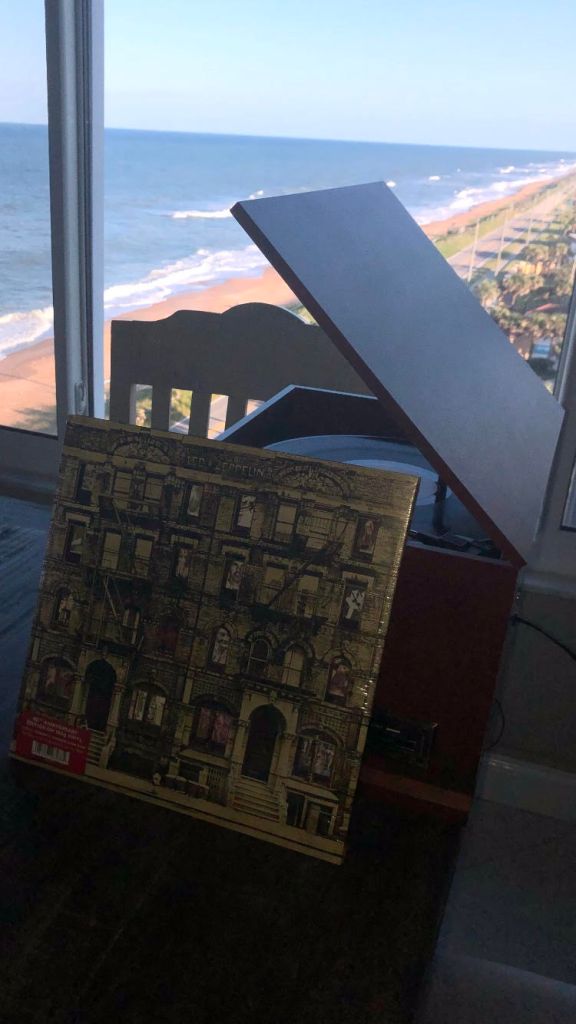
So, there we have “Physical Graffiti”, very high on my list, as you just read, for so many reasons. As I pondered how to best enjoy one of my favorite albums today, I promptly elected to go vinyl for the best of sound, and the setting wasn’t too bad either. I’m grateful to have this opportunity, and to have my love for music and life and those in my life so closely intertwined. Thank you 😊
“Oh let the sun beat down upon my face, stars fill my dream…”
“I am a traveler of both time and space, to be where I have been.”
Today is the first introduction to Canadian progressive rock band, Rush, and their second album, “Fly By Night”. That said, it is their first album with drummer and lyricist (you don’t see that combination often) Neil Peart, so as far as I’m concerned, this is their first album with their classic lineup. I know of at least one person who reads this blog who isn’t a big Rush fan, and I get that for some they are an acquired taste, but I definitely think that as far as hard rock bands, and certainly trios, there are few acts with as much musical talent as these three. Another interesting observation on Rush before we dive in, as a trio, they have to be one of the few rock acts where the lead guitarist, Alex Lifeson, is probably the least hyped and celebrated of the three. Neil Peart is among rock music’s Mount Rushmore of drummers, and Geddy Lee can literally play anything, and has a distinctive and powerful voice as well.
I listened to the album twice, and the second time through was on a much better sound system. This was an important adjustment, as it fully allowed me to appreciate the magic of Geddy Lee on bass and Neil Peart on drums. On songs like “Best I Can”, “Beneath, Between & Behind”, and one of my discovered favorites on this album, “Making Memories” these two absolutely kill it. Naturally, the title track is a well-recognized Rush classic, and the two chords that open the track are among the very few I still remember how to play on a guitar. Oddly enough, those same two chords re-emerge in the last song, “In The End”, tying it all together. Of course, it wouldn’t be a Rush album without some bizarre lyrics or song titles, and for this album’s representative, we have “By-Tor And The Snow Dog”. It’s not a bad song, if a bit long, but I have no idea what Neil and Geddy are talking about here.
As you can see, I do enjoy Rush and really appreciate the gifts this trio has to offer. Sadly, like many acts, we recently lost Neil Peart, and they are definitely on my list of regrets for never seeing them live. Thankfully we still have their recorded works, and this was a solid first offering from them.
It has been a while since we have had a Bob Dylan album to discuss, but here we are with his 1975 release “Blood on the Tracks”, which is the #9 rated album on Rolling Stone’s Top 500 Greatest Albums of All Time. I will tell you right now, this is not MY #9 rated album of all time, although it does have some positive moments. I have spoken at length previously about the collective bias at Rolling Stone for particular artists like John Lennon, Bob Dylan, and Bruce Springsteen… this is a prime example right here.
To be fair, the two most well-known songs on the album, “Tangled Up in Blue”, and in particular, “Shelter from the Storm” are Dylan tracks many know and most enjoy, myself included. “Shelter from the Storm” is definitely my favorite track on the album. There are several other tracks I enjoyed as well, to include “Simple Twist of Fate”, “Lily, Rosemary and the Jack of Hearts”, and “Bucket of Rain”. And also, to be fair, there are no other songs on the album that I really dislike.
However, there is an underlying reality that has to be addressed here. Bob Dylan will never be confused with Sam Cooke or any other remarkable vocalist. He is a songwriter, a musical poet, and a messenger of importance for many generations of music fans. It’s not my place to say he isn’t a very good singer, but by this point in his career, the flatness and tone of his voice is a distraction and detrimental component to his music, at least for me. Maybe I’m the only one, but some of these songs are just difficult to enjoy, with Bob taking the lead on vocals.
His style is unique, and in many cases, serves as an appropriate balance to his guitar and harmonica. All of that considered, I don’t listen to his music because of the gift of his voice, and I’m pretty sure I’m not on an island with that thinking. “Blood on the Tracks” has some good songs, and a couple of really good songs, but #9? I’m not buying it. Not today, not any day…
When creating my list of albums, whenever I had an artist like Elton John, who had multiple albums included on the list already, my default was to not include any “Greatest Hits” compilations, unless one of my criteria for selection forced the inclusion. Today we have just that, as the first of many “Greatest Hits” releases for Elton John, came out in late 1974, and was actually the #1 selling album of 1975. It may seem a bit redundant, as many of these tracks were either on “Honky Chateau” or “Goodbye Yellow Brick Road”, which we covered already, but the mix of songs is still so good, and there were enough new inclusions, to make it a great listening experience once again.
To start with, of the ten songs on the album, five were repeats. “Honky Cat”, “Goodbye Yellow Brick Road”, “Saturday Night’s Alright for Fighting”, “Rocket Man” and “Bennie and the Jets” are just five stellar songs that never get old, and collectively represent the diversity and greatness of Elton’s classic run in the early 1970s. That said, we do have five other songs to examine, three of which I love as much as the five above. There is one I’m not quite as crazy about, and one I just don’t really care for that much. Let’s dig in…
The opener is “Your Song”, from his second album, and his first big hit. I view this song in the same light as “Piano Man” by Billy Joel. Not only is it autobiographical, it is defining for Elton as a songwriter and performer who makes his way in life with music as his language and currency. It is a timeless ballad and a true classic. I also love the next song, “Daniel”, maybe just a little bit less than “Your Song”, but it is another song of affection for those who have a brother they love. I remember my friend John in high school and college, fondly referring to this song in reference for how much he cared about and missed his older brothers. The third “new” classic on this collection is “Don’t Let the Sun Go Down on Me”, from his recently released album “Caribou” in 1974. This song is in the same spirit and style as “Rocket Man” or “Goodbye Yellow Big Road”, all of which could be considered ballads, but big, dramatic ballads that reflect the brilliance of Elton John and Bernie Taupin as writers. Whenever I hear this song, I am always reminded of the duet performance from Elton and George Michael, which was a little over the top, but two amazing singers in one room.
The last song on the album is “Crocodile Rock”. This song is much more of a silly pop song, and while it is a very good silly pop song, it is a bit worn down and even Elton has said that when his touring days finally end, this is the one song he will be glad to never play again. So… let’s talk about the one remaining the song, “The Border Song”. It is a brooding, overwrought ballad that has never appealed to me at all, probably one of my least favorite Elton John songs. I don’t know who was picking songs for this album, but how this song was included, and “Tiny Dancer” and/or “Take Me to the Pilot” were left off, will never make any sense to me… at all.
Oh well, this is Elton John’s “Greatest Hits”, not some anonymous music fan’s collection of Elton’s “Greatest Hits”. I’m just saying…
Deeply immersed in the mid-1970s, we encounter another of the most influential singers of that time frame, the powerful and remarkable voice of Linda Ronstadt. On her fifth album, “Heart Like A Wheel”, she reached her biggest success and broke through after years of collaborating with artists like the Eagles, Jackson Browne, James Taylor, Crosby, Stills and Nash, among others. This impressive collection of songs is rated #490 on Rolling Stone’s Top 500 Albums of All Time.
The album opens with what I consider to be her hallmark song, and the best song on the record, “You’re No Good”. Written by Clint Ballard Jr, and originally performed by Dionne Warwick’s sister Dee Dee Warwick, Ronstadt certainly had the most success with this song, even though some rock fans may recognize it from Van Halen II. Anyway, the true power and depth of her voice shines through on this version, and it is a true classic. Next is a soothing Paul Anka ballad, “It Doesn’t Matter Anymore”. Ronstadt was informally mentored early in her career by Janis Joplin, and I wish Janis had also explored more of the soft side of her vocal prowess for contrast as well. Perhaps if she had more time…
Anyway, while the rest of side one is less memorable, side two kicks it back up with the Everly Brothers classic, “When Will I Be Loved”, another song that Linda makes her own. Two songs later, she does a gorgeous version of “I Can’t Help It (If I’m Still in Love With You)” by Hank Williams. One, I love that someone from Day Two of this blog is still influencing the path of musical evolution, and two, you can hear a lot of Patsy Cline-caliber country vocals here, complete with the crying steel guitar. Another country ballad follows, “Keep Me From Blowing Away”, that is a more modern take on country music while equally captivating. The album ends on a high note with a James Taylor track, “You Can Close Your Eyes”.
Like Elvis Presley many years ago, Linda Ronstadt was frequently given the high praise of a being a white vocalist who sang with the soul, passion, and quality of a black woman. I don’t think any of that matters, but no matter her appearance, at her peak, she could sing like very few others, and was so versatile and capable in many different styles and genres.
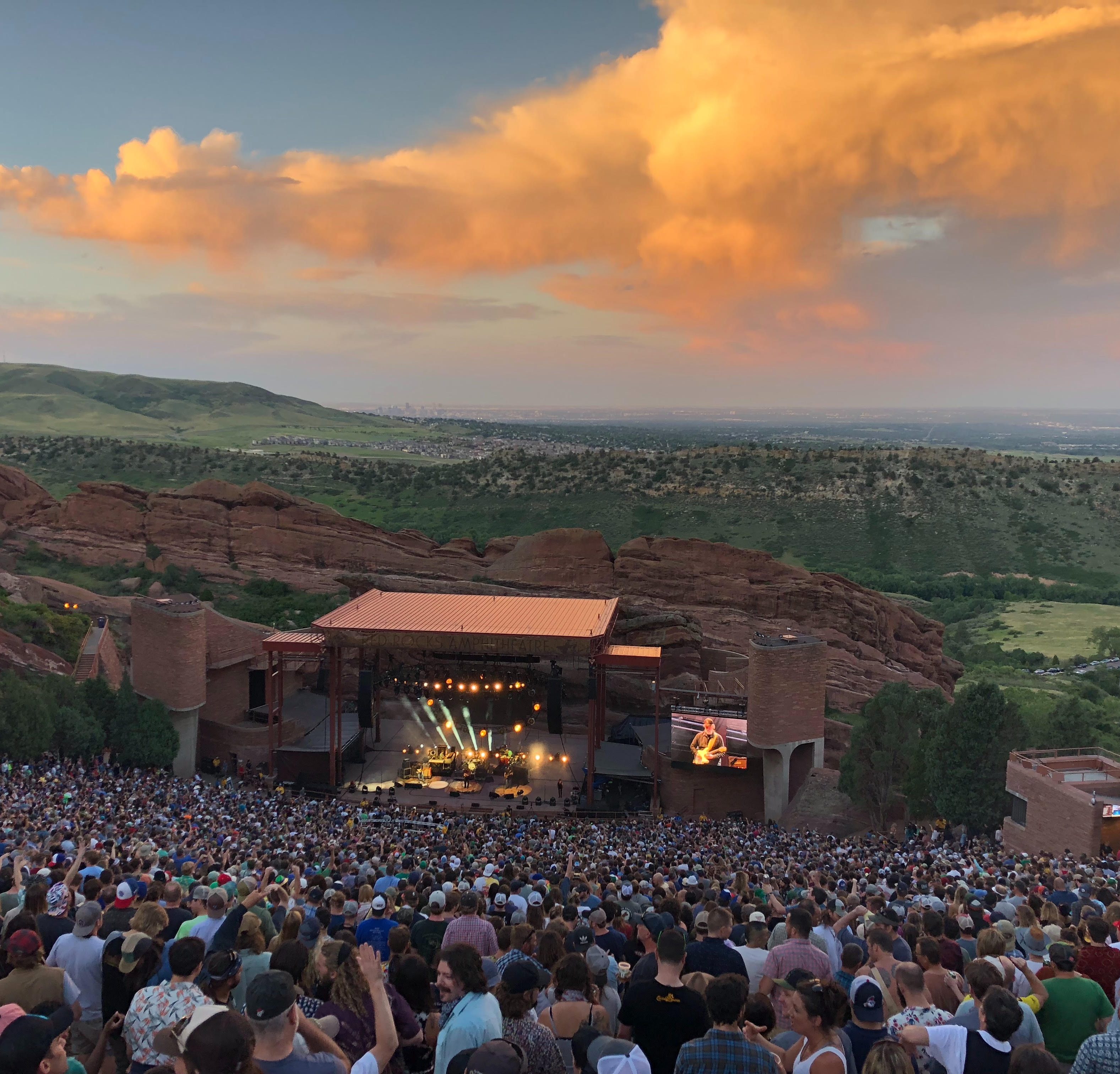
Today I chose to finally right a previous wrong, with the inclusion of “John Denver’s Greatest Hits”. This album was actually released in 1973, but there is no need to nitpick that fact. We could also possibly throw some darts at the fact that it leaves out “Annie’s Song” and “Thank God I’m A Country Boy”, both of which I love, but I chose this specific album as it was the John Denver album I wore out on my record player once upon a time. Being a Colorado native, there aren’t too many Colorado artists who have really hit the big time in popular music. Certainly some very talented artists like Judy Collins, Phillip Bailey from Earth, Wind and Fire, Firefall, The Fray, The Lumineers, Big Head Todd and the Monsters, and more recently, OneRepublic and Nathaniel Rateliff, among others. That being said, even though he isn’t a Colorado native, no artist is more closely associated with Colorado than John Denver. A statue commemorates him at Red Rocks, and his frequent references to our state are well noted in his songs.
On this album we open with “Take Me Home, Country Roads”, which is an ode to the amazing mountains of… West Virginia. OK, we can share him. It is a great song, one of his best. Much of the album is pretty soft and mellow, which works just fine. Among my favorites are “Starwood in Aspen”, his cover of Peter, Paul and Mary’s “Leaving On a Jet Plane”, and “Sunshine on My Shoulders”, which is a beautiful and warm song that goes perfectly with the sunshine and yellow aspen leaves on the cover of the record.
The balance of this commentary is reserved for “Rocky Mountain High”. Now fully celebrated as the state song of Colorado, this song has served as my informal anthem of home since I left Colorado many years ago. I love the song, the lyrics, and the duel acoustic guitars that drive the melody, and it has left me emotional on many an occasion. I remember one winter evening, when I was briefly back in Colorado visiting, and this song came on at the same time as an amazing Colorado sunset over the Rocky Mountains. I said, “Don’t ever forget this moment”… and I haven’t. I hope anyone else who has seen the same feels the same way.
“Colorado Rocky Mountain high, I’ve seen it rainin’ fire in the sky”
We can’t start a blog on the Rolling Stones without acknowledging the recent passing of drummer Charlie Watts. Charlie’s steady hand and low-key approach was in stark contrast to his bombastic peers Keith Moon and John Bonham, and was even notably lower key than the colorful Ringo Starr. That being said, his consistent approach and rock-solid presence on the stage was always a constant for this amazingly enduring and capable rock and roll band, and he will be sorely missed. Just like on all of their albums, Charlie delivered the goods on “It’s Only Rock ‘N’ Roll”, with one notable exception… the title track!
I will say, I learned something very interesting today. I have noted on previous albums that the Stones were always a bit more fluid with their lineup in the studio, with a much more frequent use of studio musicians and whoever else happened to be around at the time. I certainly never realized this carried over in a big way to the highly successful title track, “It’s Only Rock ‘N’ Roll (But I Like It)”. It just so happens, that neither Charlie Watts, Bill Wyman or even Mick Taylor had anything to do with this song. The rhythm track was actually recorded by Ronnie Wood, who would join the Stones after this album, Kenney Jones (later of The Who) on drums, and Willie Weeks on bass, all from the band The Faces. Oh, and some guy named David Bowie on backing vocals. Mick Jagger liked the track so much, he recorded the song as is with these gentlemen, and then turned it over to Keith Richards for some final guitar overdubs. Have you ever seen the video of the Stones playing this song in sailor suits dancing around in suds? I wonder how Charlie and the others felt about making this video and naming an album after a song they didn’t even play on? Definitely a unique approach for Mick and Keith in making records.
As it turns out, I still love that song, and it is the best song on an otherwise uneventful album. They do a cover of “Ain’t Too Proud to Beg” by The Temptations, and “Time Waits For No One” and “Dance Little Sister” also stand out as memorable tracks. The rest of the record is unremarkable, although laden with the same guitar-strong tracks we saw on “Exile on Main Street” and “Goats Head Soup”. As noted above, this is the last album recorded with Mick Taylor, who was a part of a very strong run for the band, as he would be replaced soon by Ronnie Wood.
No matter how it happened, it is only rock and roll, and I do like it…very much. Rest in Peace Mr. Watts, you were a classy gentleman in the midst of the debauchery of rock music.
The wave of powerhouse Stevie Wonder albums continues with “Fullfillingness’ First Finale”. Not quite as highly regarded as some of his other albums during his classic run in the mid 1970s, this album still made #9 on digitaldreamdoor.com’s Top 10 Funk albums of all time, which is interesting as I don’t think of this as a funk album in its purest sense.
To be fair, the biggest hit of the album, “You Haven’t Done Nothin’”, which represents Stevie Wonder calling out the Nixon administration, is pretty damn funky. Stevie brings back his always spectacular clavinet, and as a special treat, we have the Jackson 5 on backing vocals. Listening closely, I’m pretty sure I hear a few riffs from Michael himself. This song is outstanding, and listening to it, I’m not sure there is a Stevie Wonder song I like better than this one. I also really like the mellow opener, “Smile Please”, and the fourth song, “Boogie on Reggae Woman”, which is probably the other song that got this album on someone’s Top 10 Funk Albums. This song has almost as much bounce as “You Haven’t Done Nothin’”.
To be fair, there are some very uninteresting songs (at least to me) on this album as well. “They Won’t Go When I Go” truly sounds like funeral music, or at least a very dark classical piece, and was actually performed at Michael Jackson’s memorial service. It is complex musical composition, but just a little too sad and depressing for me. “Creepin’” is another song that doesn’t really grab my attention either. It is meandering R&B, and at a minimum, it certainly isn’t Top 10 funk music.
Even as a less than breathtaking album, there is some amazing content on this album, and beyond the Jackson 5, we also have Paul Anka, Sergio Mendes, and Deniece “Let’s Hear It for the Boy” Williams all making an appearance as backing vocals, so there is that.
Back in Florida, so it must be time for more reggae, and today was certainly an interesting choice. With the #6 album on the reggae Top Ten list, as rated by rateyourmusic.com, we have the artist Dadawah, with the album “Peace and Love”. It’s hard to describe this album in the context of typical reggae music, as I tend to associate my narrow view of reggae as mostly happy, occasionally political, but primarily upbeat sounds. This album in general, is very dark, both in sound and message, with understandably a lot of pushback and anger with regards to the oppression of slavery and discrimination.
There are only four songs on the album, and each runs approximately eight to ten minutes in length. It is certainly not the radio or beach party friendly vibes I have come to expect from other reggae pioneers like Bob Marley, Peter Tosh, or Toots and the Maytals. The album is obscure enough that I couldn’t even find it on my normal music streaming service, and had to track it down on youtube. The sound is very rhythmic, almost as if it is built off a single drum chant, and my favorite song is probably “Seventy Two Nations”. I don’t know that I will come back to this album often, but like always, I appreciate the exposure to something new and definitely respect the heart, soul, passion and musical gift associated with this record.

 A Lifetime-Plus of Music