Bunny Wailer “Blackheart Man” (1976)

     Another new dose of reggae today, with Wailers legend Bunny Wailer and his debut album, “Blackheart Man”.  Sadly, we lost Bunny earlier this year at the age of 73.  This record is rated #4 on rateyourmusic.com’s Top 10 Reggae Albums of All Time.

     As much as I enjoy reggae music, if I had any knock against it, it would be the somewhat repetitive sound of each song.  The best ones obviously find a way to introduce variation and unique structures to their songs, and I heard a lot of that on this album.  Additionally, the vocal style of Bunny was different than any other reggae singer I have encountered.  At times, it almost felt as if I was listening to a Jamaican crooner, with a reggae back-beat coming from around the turn.  His enunciation and delivery were just very unique, and many of the songs, including the first one, the title track, had a very unusual evolution of chords and keys.  In particular, I really enjoyed the last song, “This Train”, and the one right before it, “Bide Up”.  Like the other artists of this era, there is a strong linkage to the Rastafarian ways, with a notable focus on the beauty of nature and overcoming oppression.

     It is amazing to think about Marley, Tosh, and Bunny Wailer all coming from the same group.  It is easy to say they are the Lennon, McCartney and Harrison of the reggae surge.  Like most of the top-notch reggae music I have experienced here, it was a mellow and pleasant listen and another opened door for my moments of beach life and sunshine.

Boston “Boston” (1976)

     I have been looking forward to today’s album, as I consider it to be very unique for one notable reason.  In my years of listening to rock music, I can’t think of any other record besides this one, where every single song, without exception, is broadly played and recognized in radio rotation.  The debut album of the band Boston, simply titled “Boston”, was truly remarkable in that regard.  In my formative years listening to what we now refer to as classic rock, I never paid that much attention to Boston.  They had what seemed to be a very limited number of albums and songs, which is still true, and candidly, in comparison to some of the dominant bands of the time, I always thought they were a bit one (or two) dimensional, with a strong lead guitar and vocal pairing, but no depth or notable accompaniment from bass and drums, leaving their sound a bit “thin”.  However, a few years ago, I looked more closely at their debut album, and realized that not only did I really appreciate many of the songs on this album, I also discovered this “eight for eight” achievement and how impressive that was, particularly in a debut album.

     As noted above, Boston was primarily the pairing of Tom Scholz, the founder and creative leader of the band, on guitar, and Brad Delp, who had amazing range and strength with his high tenor vocals.  The album opens with “More Than a Feeling”, and it just goes from there, one big hit after another.  Next is “Peace of Mind”, which once upon a time captured my attention with this verse, “Now you’re climbing to the top of the company ladder, Hope it doesn’t take too long, Can’t you see there’ll come a day when it won’t matter, Come a day when you’ll be gone.”  Reasonably profound and very true, Mr. Delp.  Side one ends with the guitar explosion that is “Foreplay/Long Time”, a true air guitar classic of the 1970s.

     Side two opens with the autobiographical track “Rock & Roll Band”, which I have always enjoyed, including its references to being a New England-based band.   The up-tempo continues with “Smokin’”, another guitar rock classic, and then the pace shifts with “Hitch a Ride”, which was served as the anthem for our hitch-hiking days growing up.  In the small town we grew up in, hitching was a necessity to get from one of two central areas to the other, and although that may sound like a terrible choice, we usually got picked up by someone’s surprised parents so it wasn’t too treacherous.  My all-time favorite hitch-hiking story is my friend Mike and I electing to decline a 75-mile ride from Greeley to Parker during college, because we thought hitching would be a “better experience”.  After about 7 hours, four or five short rides and a lot of rain, we finally caved in and called my dad to come get us.  Good call, Mike…

     The last two songs are both on the slower side but like the others, classic rock radio staples, “Something About You” and “Let Me Take You Home Tonight”.  Eight songs in all, eight songs that all heavily fill the rotation to this day.  It really was a remarkable debut performance, and although I don’t say this often, I don’t possibly understand how this blockbuster was left off the Rolling Stone Top 500 list.

AC/DC “High Voltage” (1976)

     Another of the most formative bands in my life makes their debut in the blog today, with the first internationally released album from AC/DC, “High Voltage”.  At the heart of this band were the Young brothers, with Angus on lead guitar, and Malcolm on the equally essential rhythm guitar, and their own outrageous lead singer, Bon Scott.  Although some listeners and critics wanted to lump AC/DC in with the punk rock movement, it was a much more basic and simple rock and roll sound, just a bit louder and rougher than their predecessors.  It has been said that AC/DC has made an entire career playing the same three chords, and while that certainly is an oversimplification, more so than just about any long-living band I can think of, they have stayed true to their formula and sound, over the course of almost 50 years and many lineup shifts.

     AC/DC was my first true rock concert, at McNichols Arena in Denver in the winter of 1982 with friends Mike and Nevin.  I have always loved the raw purity of this band, and this first album is no exception.  The first two songs, “It’s A Long Way to the Top (If You Wanna Rock ‘n’ Roll)”, and “Rock ‘n’ Roll Singer” most certainly use the exact same chords, but they both rock in a unique manner, with the first song featuring a heavy dose of bagpipes.  (I’m pretty sure that is the first time I have mentioned bagpipes in this blog).  AC/DC, who along with ZZ Top mastered the double entendre, gives us “The Jack”, a bluesy rocker that tells the story of an unfortunate sordid encounter with an experienced female through the dialect of a card game.  Who says they weren’t always being creative?

     Side two opens with a rocker that remains highly popular today, “T.N.T.”, and they keep us slightly uncomfortable, yet rocking at a driving pace, with “Can I Sit Next to You Girl”, “Little Lover”, and “She’s Got Balls”.  The album concludes with the title track, and let there be no doubt, they live up to all of it as this is truly “High… Voltage… Rock ‘n’ Roll”.

     In their earliest days, AC/DC were considered by many to be the next and newest lowest common denominator in rock ‘n’ roll.  However, by remaining consistent in their approach and steady and strong with their content and performances, they have endured for so long and done so much they are regarded as hard rock royalty.  There is much more to look forward to with this band, and in the late 1970s they provided a much-needed infusion of guitar rock as others were beginning to slip and struggle.

The Rolling Stones “Black and Blue” (1976)

     As the winds of change were blowing across the world of rock music in 1976, the Rolling Stones were dealing with multiple evolutionary components themselves.  This marked the release of “Black and Blue” to mixed results.  Notably, this was the first album without Mick Taylor in the band, and although Ronnie Wood did make some limited appearances on the album, almost all of the guitar work was handled exclusively by Keith Richards.  Additionally, the Stones continued to try and grow and reshape with the times, and their sound on this album has a bit more funk, rhythm and blues, and even a straight-up reggae number.

     As the band moved further and further away from the guitar-rock core of “Exile on Main Street”, I don’t find a lot on this album that really sticks with me, even after multiple listens.  The one notable single release was “Fool to Cry”, which is almost a little too much Mick Jagger for me.  It’s a decent song, but something about his falsetto on this song has always left me a bit sideways.  I feel the same way about “Hot Stuff”, which feels like a preview of where they were headed next in their late 70s co-existence with disco and dance music.  I did enjoy hearing the reggae track “Cherry Oh Baby”, and I know they were influenced greatly by the emergence of Bob Marley and Peter Tosh.  I consider this the most memorable moment on the album.

      The rest of the record doesn’t do much for me, although once again, I appreciate the dual vocals of Mick & Keith on “Memory Motel”.  This album feels more like an album they had to make, versus one they wanted to make.

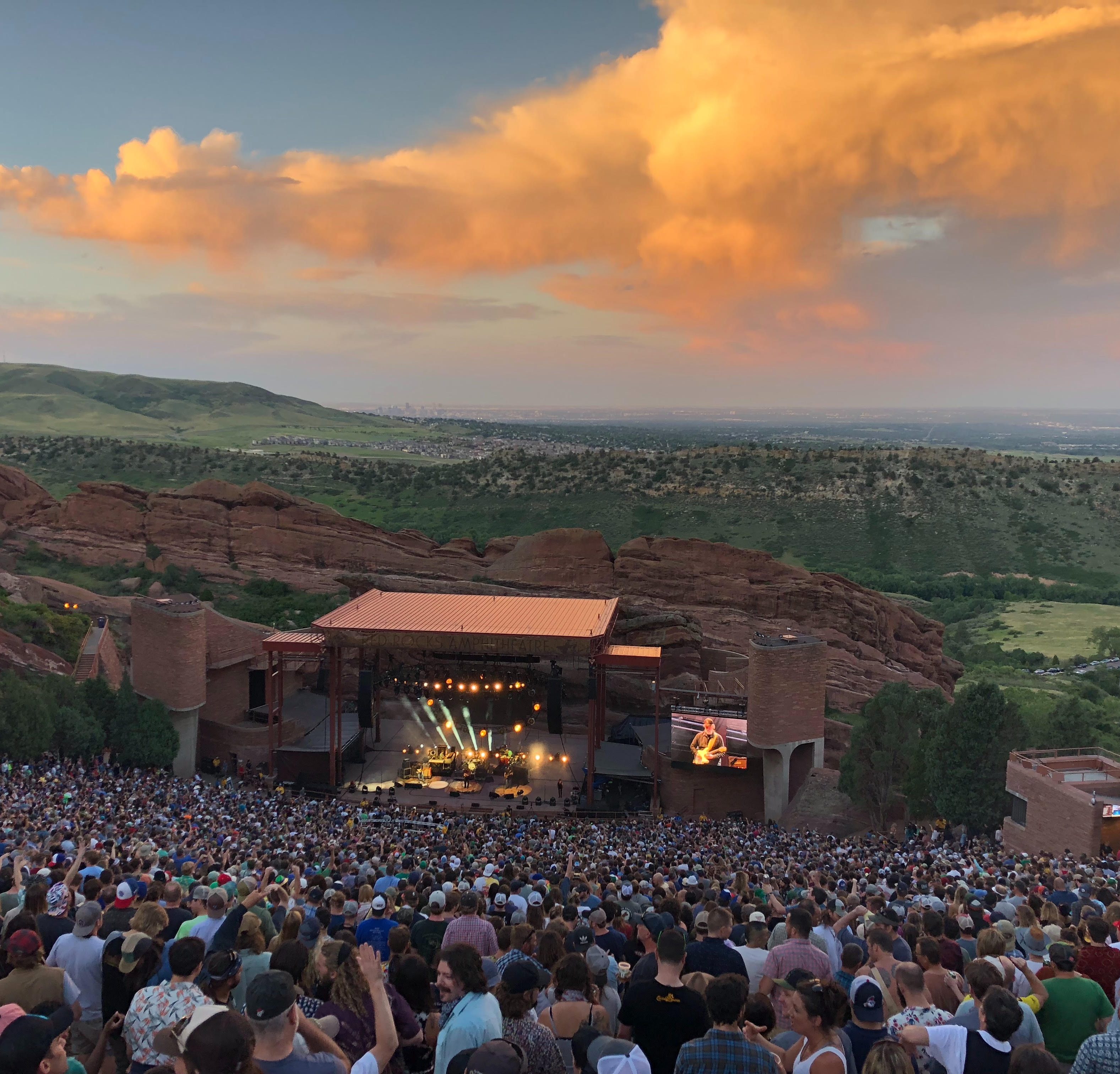
     One last footnote for today, I was fortunate enough to participate in a panel discussion with a real expert on rock music, legendary Denver Post music writer G. Brown.  We covered a lot of topics, including the highlights and lowlights of Red Rocks Amphitheater, which adorns the cover photo of this blog.  We heard some great stories about how Denver’s music scene expanded from another uninteresting stop between Kansas City and California into a can’t-miss destination for all artists crossing America.  Thanks to G. Brown for all of your amazing anecdotes, and of course, thanks to my good friend Jim for being the king of downtown Denver for decades.  Mutiny Information Café is where it all happens, seven days a week in Denver and Trinidad, Colorado.  Check it out…

The Ramones “The Ramones” (1976)

     You know how you always want things to be different than they are now?  If it is hot, you want it a little colder.  If it is cold, you want it a little warmer.  As much as I have enjoyed the steady diet of extended-length songs and a good run of classic and progressive rock, today’s album is a welcome change of pace.  Clearly, with the ultimate success of this album and the movement followed, the rest of the music world was ready for a change as well.  Today we feature the debut album, “The Ramones”, naturally performed by the Ramones, from the heart of Queens in New York City.  True pioneers of punk rock, this album is rated #47 on Rolling Stone’s Top 500 Greatest Albums of All Time, and is the #2 punk rock album of all time, as rated by loudersound.com.

     Dismissing wandering jams and drifting melodies, every song on this album is short, typically around 2 minutes in length, intense and upbeat in structure, with no guitar solos to speak of at all.  Just fast, grinding chords and the clever lyrics and surprisingly melodic sounds of the Ramones.  For those of you who may not know, the Ramones were four guys, each with the adopted last name of Ramone, even though none were related.  Singer and leader Joey Ramone led the action and drove the pace.  The album opens with a song most will quickly recognize, “Blitzkrieg Bop”.  The first single and a classic still today, it is a great song, and also known to me as the song the Griswold kids used to drown out Clark and Ellen after they belted out “Mockingbird”.

     The rest of the album rocks on at the same frenzied pace, fourteen short songs in total.  After the oddly aggressive “Beat on the Brat”, we have the curiously sweet punk love song, “I Wanna Be Your Boyfriend”.   Another of my favorite songs on this album is on the second side, “53rd & 3rd”, and while none of the other songs jumped out to me, they all carry the flag without a miss, and this is definitely a solid album from beginning to end.

     Sadly, none of the original Ramones are still alive, but the legacy they left at the front end of the punk rock movement, especially as an American act, will live on forever.  They are living proof that a rocker of any sort just can’t wear too much black, and in such an unintended way, were perpetually cool in their delivery.

Rush “2112” (1976)

     Today is an extension of the progressive sounds from yesterday’s album, “Presence” by Led Zeppelin, with the corresponding release of “2112” by Rush.  There are definitely some similarities between “Achilles Last Stand” and the “2112 Overture”.  In both cases, the instrumental performances are phenomenal, particularly the drumming, and the fantasy-based themes are also similar, with one focusing on world exploration, the other on a future world of technology vs. music.

     As noted previously, Rush has the unusual circumstance of their lyrics being written by their drummer, Neil Peart.  The entire first side of the album is a 20-minute medley of short songs, telling the story of a future time when an oppressive government regime has outlawed music, art and expression.  The protagonist finds a lost guitar, and attempts to bring new light to this dark world.  Tragically, he is ultimately crushed by the authorities and takes his own life in fury, and following more conflict, the tale ends with the ominous sounds from the oppressors, “We have assumed control… we have assumed control.”  Forty-five years later, it comes across as a bit absurd at times, but a noble attempt at looking forward and expressing the concerns of compromising art for authority.  Music, this is Rush at their very best.  The first opening segment, “Overture” and “The Temples of Syrinx”, is possibly the best example of hard rock drumming I have ever heard by anyone not named John Bonham.  Neil Peart’s work on this album is spectacular, and quickly cemented his place in the Mount Rushmore of rock drummers.  The rest of the story has similar moments of greatness, although if you really want to capture the best of this piece, you can pick it up through the first six minutes or so.  The story is reasonably easy to follow, and Geddy Lee alters his voice between soft and intense, depending on if he is speaking for the protagonist or the oppressors.

     Side two is a lighter collection of stand-alone songs.  “A Passage To Bangkok” is one of the best, other than the culturally outdated riff that is identical to the opening of “Turning Japanese” by The Vapors.  My other favorite of these songs is “Lessons”.  Oddly, there is Rush attempting a ballad of some sort on “Tears”, but at this point, I have already embraced their mechanical and robotic approach to story-telling, so it feels a bit out of place.

     I believe many Rush fans look at this album, particularly the side one medley, as one of their greatest moments, and I can’t disagree.  The progressive themes and Geddy Lee’s voice aren’t for everyone, but there is no denying how talented and synchronized this group was, delivering a sound that is tight and colossal.

Led Zeppelin “Presence” (1976)

     I have a lot to say about today’s album, “Presence” by Led Zeppelin.  Most of you know I am a die-hard Led Zeppelin fan, and for most of their first seven years, there was very little they could do wrong.  However, misfortune, questionable choices, and wear and tear began to take their toll on the band, and in August of 1975, singer Robert Plant and his wife and family were involved in an auto accident that left Plant in a wheelchair with several broken bones as the band gathered to record their next album.

    The album was by comparison, a relatively unsuccessful album for the band, both commercially and in review and radio play, and I will explore some of my theories as to what went wrong on this album before I look more closely at the individual songs.  First off, to be clear, this is an album creatively dominated by guitarist Jimmy Page.  Unlike their first six albums, John Paul Jones plays bass and only bass on this album.  No keyboards, no arranged strings, no mandolins, no anything other than Page’s guitar and Jones on bass.  I feel this led to a creative imbalance and disruption to the four-part harmony of the band.  We already know Plant wasn’t in a great place for this record, and I can’t imagine Jones welcomed this relegated role either.  This imbalance would shift too far the other direction on their next record, for different reasons.

     Even though I have listened to this record hundreds of times, I reached my second conclusion just today after another listen.  As a guitar-heavy album where Page was trying to restore and extend Led Zeppelin as the premier hard rock band in the world, I realized that Plant was no longer the vocalist they needed to sing most of the songs on this album.  The intensity of these songs needed 1969 Robert Plant.  He was no longer that singer, and he wasn’t yet 1982 Robert Plant either, singing “Sea of Love” or “In The Mood”.  What we have is him straining to keep pace, and it just doesn’t work the same way.  Not only did he struggle in-studio, his live work from 1975 through the end of the band in 1980 was marred by consistent cracks and missed notes.  As difficult as I think this record may have been for him vocally due to loss of range, it also was exacerbated by his injuries and what I would consider to be an overall lack of joy and fun on this record, a big change from the last several albums.  There is only one song on this entire album where I hear that happiness unleashed, and not surprisingly, it is my favorite overall song on the record.

     The album opens with the gigantic song, “Achilles Last Stand”.  Considered by many to be their last epic track, in the same vein as “Stairway to Heaven” and “Kashmir”, there is some great commentary on this song and album on a recent podcast by Plant.  He hits on two key points.  The first, as noted above, is that “Presence” and this song in particular, is not a “comfortable listen”.  Intense and fierce, if somewhat devoid of passion and emotion, this song also highlights Plant’s other point.  As one who doesn’t frequently look back with fondness, he marvels at the “insane musicality” of Page, Jones, and drummer John Bonham.  Within this genre and most others, there just wasn’t a more talented and powerful trio of musicians, and it is on full display on this 10-minute adventure.

     Next comes “For Your Life”, and this song is a continuation of my theme.  Grinding and thundering in its delivery, the song lacks much melody or range, as well as an appealing hook.  The last song of side one is “Royal Orleans”, one of the lighter moments on the album, at least lyrically, as the band laughs at an alleged late-night encounter with a pretty girl in New Orleans who turned out not to be a girl after all.

“A man I know, went down to Louisiana, Had himself a bad, bad fight.  And when the sun peeked through, John Cameron with Suzanna, He kissed the whiskers, left and right… Whiskers.”

It was supposedly John Paul Jones who made this famous misstep, but who knows where the truth ends and the myth begins.

     Side two opens with another track that displays that the band, at its best, was still capable of greatness.  “Nobody’s Fault But Mine”, a remake of an old blues track by Blind Willie Johnson, features an incredible opening guitar buzz from Page, more outrageous drumming from Bonham, and a surprisingly strong harmonica solo from Plant.  As great as this track is, going back to my point above, imagine if you can, 1969 Robert Plant singing this same song.

     Plant finally gets his rockabilly knock-off song, “Candy Store Rock”, and while the attempt is noble, somehow the actual result isn’t nearly as much fun as it was intended to be.  Thankfully, they really got it right on the next song; the one song I noted above, where I think past, present and future Robert Plant shows up at the same time, along with the band having fun and playing loose and tight all at once.  The track is “Hots on for Nowhere”.  Unless you are a die-hard, you probably won’t recognize it, but it is definitely worth a listen, and great flashback to the happiness and diverse sounds of “Houses of the Holy” and “Physical Graffiti”.

    The album ends with the extended blues track “Tea for One”, which is a restructured replication of “Since I’ve Been Loving You”, just darker and more despondent.  Gone is Jones’ melodic organ, it is just him on bass next to Page’s guitar, with Plant lamenting his desperate loneliness as “twenty-four hours slips into days, a minute feels like a lifetime, when I feel this way

     A dark ending to a dark album, and sadly the beginning of Led Zeppelin’s descent from their peak of greatness.  There would still be moments of magic here and there, but more or less, the best days of this band were behind them as a group, with tougher days ahead.
David Bowie “Station to Station” (1976)

     Today brings another highly acclaimed David Bowie album, with the release of “Station to Station”.  This album is an interesting mix of songs, and is rated fairly high, at #52 on Rolling Stone’s Top 500 Greatest Albums of All Time.  I don’t think I see it quite as favorably, although there are some high points.

     The album opens with the ten-minute title track, which feels a little bit like the “Abbey Road” medley as a collection of mini-songs strung together.  The core of the song starts with a really funky riff that I love, and Bowie’s unique vocals compliment the song nicely.  I’m not sure there are ten minutes of purpose in this song, but I do like the core.  Next comes the one big hit single from the album “Golden Years”, a staple of his greatest hits, and certainly a great song.  I really liked the next song “Word on a Wing”, it has an unusual but beautiful medley, and is probably my favorite discovery on the record.

     “TVC15” comes next, and to me, this sounds like David Bowie copying David Byrne, which is highly unlikely in 1976, so I guess I will have to ask, who influenced who?  It is a great song that really grows on you.  The last two songs aren’t quite as interesting to me, but overall, this is another creative Bowie album he managed to pull together at the height of his drug addiction.  I certainly marvel at his ability to write, perform, and deliver this kind of content while mired in that struggle.

Peter Frampton “Frampton Comes Alive!” (1976)

    As we leap forward into 1976, America’s Bicentennial, the best-selling album of the year is the first one we encounter, released in early January of 1976.  The live double-album smash sensation that is and was “Frampton Comes Alive”, by guitarist and vocalist Peter Frampton, is today’s discovery, before his ill-fated “Sgt. Pepper” movie with the Bee Gees.  This is one of two mainstream albums in 1976 that I’m a little surprised did not make the Rolling Stone Top 500 lists, but as noted, it was extremely successful commercially and the number-one selling album of the year.

     It is not uncommon for me to come across an album that has one or several songs I know extremely well, and the rest of the album is a mystery to me, at least going in.  Anyone who has listened to more than ten minutes of classic rock has certainly heard the three singles from this album, “Baby, I Love Your Way”, “Show Me the Way”, and “Do You Feel Like We Do”, which is a great song but hard to envision as a 13-minute single.  I probably should have picked up on this earlier, but I learned today when I randomly came across a Frampton performance on Howard Stern (or my smart phone was just being smart again), that “Do You Feel Like We Do” is essentially a song about a really painful hangover, and the possible temptation to head back down that dark road again.  I think I was always distracted by the unique talk box guitar solo.  Further research also confirms the single version was obviously edited down, but still a rather long track.

     So, once we acknowledge the popularity and significance of those three hits, all of which I do like, we have the rest of the album.  I think his cover of “Jumping Jack Flash” is the perfect metaphor for how I view the rest of this double-album worth of material.  I have always thought the perfect song to audition any up-and-coming garage rock band is “Jumping Jack Flash”.  It has a really funky groove, so we can find out how good the bass and drums stand out, the guitar work features a legendary riff and the opportunity for a stellar solo if the band can bring it, and of course the vocal lead is front and center for all to see.  Any good band should be able to make this song sound good.  And while Peter Frampton is a phenomenal guitar player and a decent singer, this version is a sleep-walk.  It is slow, meandering, and just never grabs your attention.  Unfortunately, that is exactly how I feel about the rest of the album.  I listened to it several times to give it the benefit of the doubt, but after three times through, if it isn’t happening, it isn’t happening.

     So, I will close on a positive note.  Peter Frampton is a really talented guitarist who has created some timeless contributions to rock music, almost all of which are featured on this album.  You could even argue this was a great party album in its day, as the attendees could jam out in elated happiness when one of the songs we all knew came on, and the rest of the album probably served as reasonable background music for thousands and thousands of lost keggers in the 1970s.

Burning Spear “Marcus Garvey” (1975)

    Today we take on a highly acclaimed and controversial album in the world of reggae, with the artist Burning Spear and his album “Marcus Garvey”, a tribute to the Jamaican black separatist Marcus Garvey.  To this day, I still recall the Marcus Garvey Cultural Center at my alma mater in Colorado, and admire his legacy of resistance, even though like many heroes of the time, his background also has some less celebrated and more complicated views on world balance and equity.  This album is rated #2 on rateyourmusic.com’s Top 10 Reggae Albums of All Time.

     Musically, the album is very inviting and the groove of the reggae beat rings out very authentically and consistently throughout the record.  There aren’t many songs that stand out, as it is a pretty steady sound across the album, but I do like the chill “Live Good”, and there is an interesting samba-sound that opens “Jordan River”.  The production quality and the musicianship, which is often very subtle and under-produced in reggae, is really well done and the entire album is just easy to take in, especially on a late night by the humid air and rolling seas outside my window.

     I have really enjoyed stretching my boundaries with the new reggae music I am learning along the way, and in addition to my master playlist, I have an “island” playlist that is becoming greatly enriched with the inclusion of artists like Burning Spear.